Se reafirma el valor clínico de la calprotectina fecal: una nueva herramienta de diagnóstico precoz para la enterocolitis necrotizante en lactantes prematuros.
Necrotizing Enterocolitis (NEC) is one of the most critical intestinal emergencies affecting preterm infants, characterized by challenging early diagnosis and rapid disease progression. As a non-invasive, intestinal-specific inflammatory biomarker, fecal calprotectin (FC) has attracted extensive research attention in recent years. In July 2025, a single-center study conducted by Zunyi First People’s Hospital was published in Frontiers in Pediatrics, systematically evaluating the efficacy of FC in the early diagnosis and severity assessment of NEC among preterm infants. Notably, the calprotectin test kits adopted in this research were supplied by Xiamen Wiz Biotech Co., Ltd., further validating the clinical application value of the company's non-invasive intestinal inflammation detection products.
Research Background
NEC predominantly occurs in preterm infants with a high mortality rate. Surviving patients may suffer severe long-term complications including short bowel syndrome, intestinal stricture, and neurodevelopmental disorders. Current NEC diagnosis relies on clinical manifestations, laboratory tests and abdominal X-ray imaging, while high-sensitivity and high-specificity early biomarkers remain scarce.
Derived from neutrophils, fecal calprotectin rises drastically during intestinal inflammation. Its non-invasive sampling and convenient testing make it a promising candidate for routine NEC screening.
Study Design
Study Subjects: NEC group: 84 preterm infants, Feeding intolerance group: 84 preterm infants, Healthy control group: 168 preterm infants
Study Period: September 2021 – June 2024
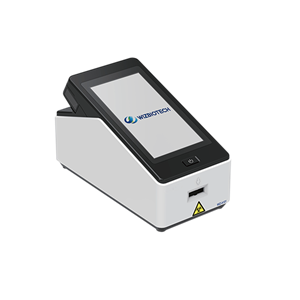
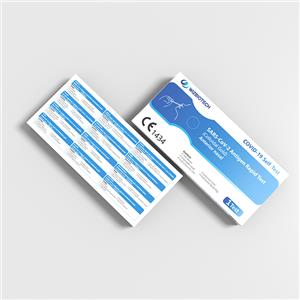
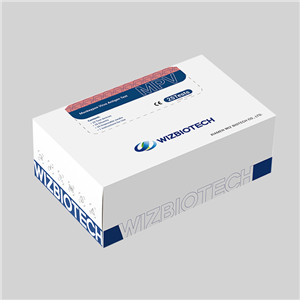
Detection Method: FC concentrations were measured via immunochromatographic assay using test kits manufactured by Xiamen Wiz Biotech Co., Ltd.
Statistical Analysis: ROC curve analysis, Spearman correlation analysis, non-parametric tests
Key Research Findings
Significant FC elevation in NEC patients enables differentiation between NEC and non-NEC conditions.
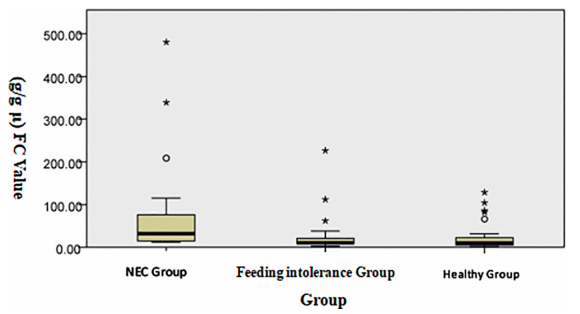
The median FC level of the NEC group was markedly higher than that of the feeding intolerance group and healthy control group.
No statistically significant difference in FC levels was observed between the feeding intolerance group and healthy controls.
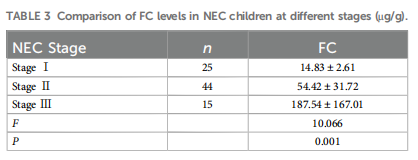
FC concentration positively correlates with NEC severity FC levels followed the ranking: Stage III > Stage II > Stage I (P < 0.05)
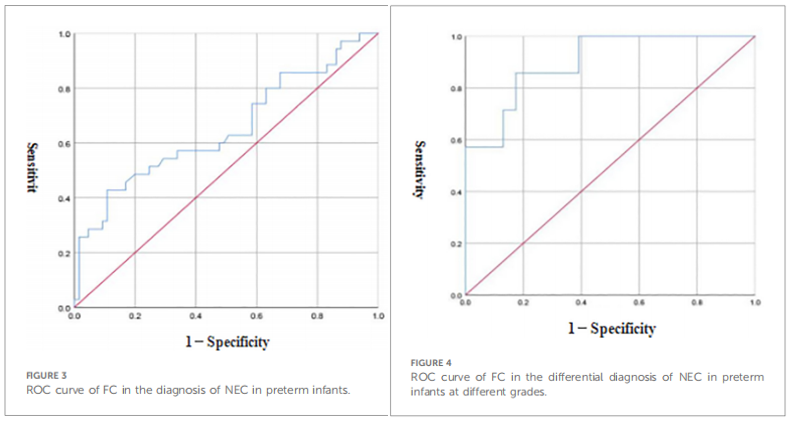
Diagnostic performance of FC for NEC (ROC Curve Analysis) ROC analysis identified the optimal FC cut-off values for general NEC diagnosis and moderate-severe NEC stratification as 8.40 μg/g and 53.50 μg/g respectively:
For general NEC diagnosis: AUC = 0.651, sensitivity = 42.86%, specificity = 89.23%
For moderate-severe NEC identification: AUC = 0.901, sensitivity = 85.71%, specificity = 82.61%
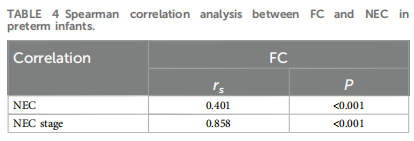
Correlation analysis Spearman correlation analysis confirmed that FC levels are positively correlated with both the incidence and severity of NEC in preterm infants.
Ventajas para la investigación y relevancia clínica
Toma de muestras no invasiva y sencilla: Las muestras de heces son fácilmente accesibles, lo que facilita la monitorización continua de los recién nacidos prematuros.
Excelente repetibilidad: la calprotectina permanece estable en las heces con una degradación mínima.
Apoya el manejo clínico estratificado. Los niveles de FC superiores a 53,5 μg/g indican un alto riesgo de enterocolitis necrosante moderada a grave, lo que ayuda a la toma de decisiones clínicas.
Compensa las desventajas de las pruebas convencionales: los análisis de sangre tradicionales implican toma de muestras invasiva y tienen una especificidad baja; la FC proporciona una solución diagnóstica auxiliar no invasiva alternativa.
Limitaciones del estudio
Diseño de centro único con tamaño de muestra limitado. Solo se incluyeron 84 sujetos en el grupo NEC, lo que puede introducir un sesgo de selección.
Falta de protocolos de prueba estandarizados. Los valores límite varían entre fabricantes, lo que impide la extrapolación directa de resultados entre diferentes marcas.
Factores de confusión no controlados, como la edad posnatal. Estudios previos han demostrado que los niveles de FC están asociados con la edad posnatal, que no se ajustó completamente en este ensayo.
AUC moderado para la detección temprana general de NEC (0,651). La FC por sí sola tiene un poder diagnóstico limitado para la detección temprana de NEC, y se recomienda la prueba combinada de biomarcadores.
Resumen
La calprotectina fecal es un biomarcador auxiliar eficaz para la detección y evaluación de la gravedad de la enterocolitis necrosante (ECN) en recién nacidos prematuros, con un excelente rendimiento predictivo para la ECN moderada a grave. Se requieren más ensayos multicéntricos con muestras grandes para establecer umbrales de corte universales estandarizados.